
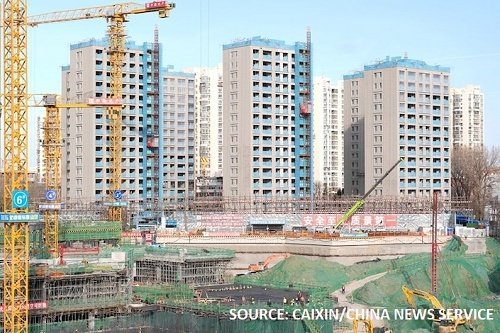
China’s property crisis has been building for years. And last week, Beijing’s Central Economic Work Conference agreed that resolving it was the top priority in 2026, as Caixin confirms:
“It required officials to focus on stabilizing the real estate market, outlining a strategy to ‘control new supply, reduce inventories and optimize offerings’ based on specific local market conditions.”
The question is whether it is possible to actually resolve the crisis. Or has it become “too big to solve”?
CHINA NOW HAS 27 MONTHS OF HOUSING INVENTORY
The bubble began to burst when President Xi introduced his “3 red lines” policy in 2020, to curb speculative property development:
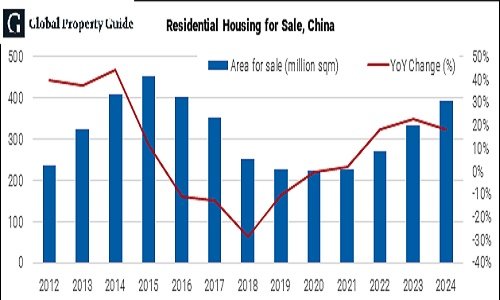
- Buyers stepped back, and inventory began to build as the Global Property Guide chart shows
- Inventory rose by 20%/year in 2022, 2023 and 2024; the area for sale has now doubled since 2021
- Tier 1 cities have 17 months of inventory; Tier 2 have 23 months; Tier 3/Tier 4 have 40 months
By comparison, it normally takes only 47 – 62 days to sell a home in the USA, and 6 months in the UK, Germany and Japan.
Today, the crisis is continuing to build:
- The ratio of housing starts to sales has fallen to 59.5%
- This is the lowest level since records began in 2000
- Before then, almost all property was owned by the state
This key fact highlights a super-critical issue. China has never gone through a full ‘property cycle’. Prices have only ever gone up since 2000, till now.
So nobody knows what normally happens in a downturn.
LOCAL GOVERNMENT FINANCES ARE ALREADY AT RISK
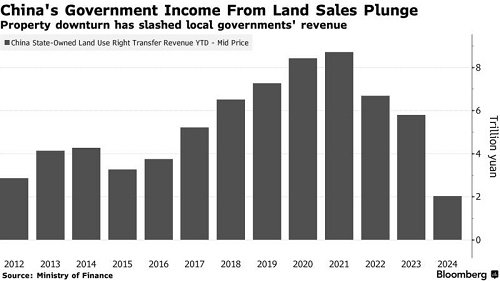 The crisis doesn’t just involve property. Local government finances are also at risk.
The reason is that China doesn’t have local taxes. Instead, 40% of local government revenue has historically come from land sales to developers:
- The property market collapse means they are now in a ‘debt trap’
- Local government debt has now risen to $18.9tn, similar to China’s GDP
- 2/3rds of new debt is being used to pay old debt
Developers still own 22000 hectares of high-priced land bought before the crisis. This will have to be written off before major new sales can begin.
CHINA’S HOME PRICES ARE ALREADY IN FREEFALL
The US subprime bubble in 2004-8 led to the Great Financial Crisis in 2008. But China’s property bubble has been ‘subprime on steroids‘ by comparison:
- China’s keeps wages very low to support exports, so household wealth is 70% based on housing
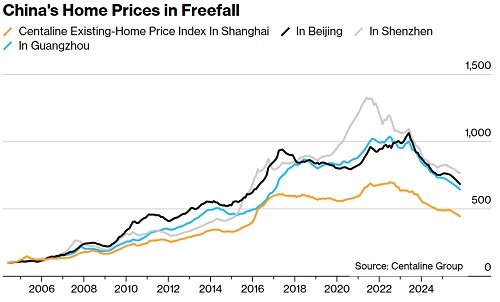
- Today, prices are already in freefall, as the Bloomberg chart shows
Construction, which used to be 29% of GDP, is also now in crisis:
- Evergrande, the world’s most indebted property developer was wound up earlier this year, with $300bn of debt
- China Vanke, formerly China’s largest homebuilder by sales, is struggling to reschedule its debts
- Many of today’s unsold homes are only half-built as developers ran out of money
- 2/3rds of new homes delivered this year have been officially rated “poor quality” – and may be unsellable.
EVERY 100 ADULTS TODAY WILL HAVE ONLY 12 GREAT-GRANDCHILDREN
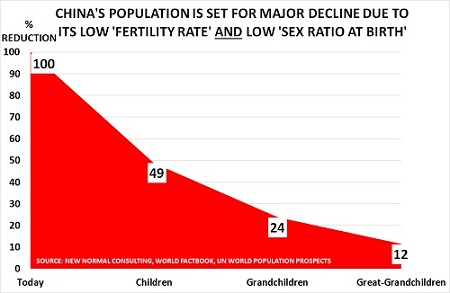
The decision to settle down and have children is a key driver for home buying. And the root cause of today’s triple crisis is China’s lack of babies.
China introduced its One Child Policy in 1980. And fertility rates quickly began to tumble below the replacement level of 2.1 babies/woman.
And at the same time, the Sex Ratio at Birth (SRB) began to climb:
- 81% of the population lived in rural area, and many parents wanted boy babies to work on their farm
- So the boy: girl ratio soared to >115: 100 as China allowed easy access to sex-testing and abortion
- The Economist noted China had ‘lost’ 60m girls by 2018, versus a normal 104 boys: 100 girls ratio
- China’s UN Family Planning Association reported that 2020’s SRB was still 110: 100
It is still high today:
- China’s current SRB 109 boys; 100 girls is second only to India in the G10 countries
- Its fertility rate of 1.02 babies/woman is easily the lowest in the G10 countries
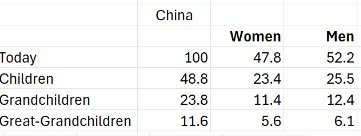 These numbers mean, as the table shows:
- 47.8 of every 100 adults today are women
- These women will have only 23.4 girl babies
- These girls will have only 11.4 girl babies and…
- So every 100 adults today will have just 11.6 great-grandchildren
The US subprime crisis in 2008 led to the Great Financial Crisis. Now 2026 seems set to be the year that China tries to solve its ‘subprime on steroids’ crisis – in its property market, construction sector, and local government finances. But its fundamental problem – the lack of babies – seems as far from solution as ever.