
 Europe is finally moving to control Chinese imports, to protect vital industries such as autos and chemicals, as we discussed earlier this month:
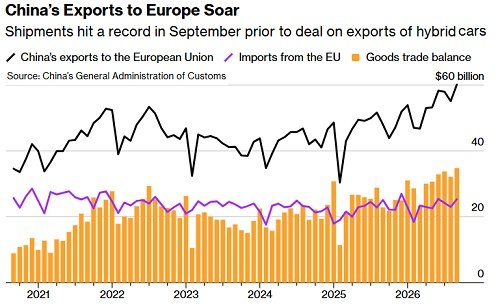
- China’s exports to the region hit a new record last month, as the Bloomberg chart shows
- They jumped from $23bn in September last year to $35bn, a 25% increase
- Europe’s exports to China have been stuck at ~$25bn for the past 5 years
CHINA’S HYBRID AUTO EXPORTS ARE DESTROYING EUROPE’S INDUSTRY
Autos are Europe’s largest manufacturing industry, responsible for millions of well-paying jobs directly and through the supply chain:
- China had just 2.7% of the market in September 2024, as the Bloomberg chart shows
- This share had jumped to 15.6% in September last year
- And they are now taking more than 25% of the market
Clearly this would destroy Europe’s own industry if it was allowed to continue.
The key was a series of visits to Beijing by Maros Sefcovic, the EU’s Trade chief.
He agreed a cap of 350k hybrid imports/year, starting in December, and increasing by 6%/year. Without the cap, they were expected to hit a total of 800k/year this year.
CHEMICALS IS HIGH ON THE EU’S LIST FOR FURTHER ACTION
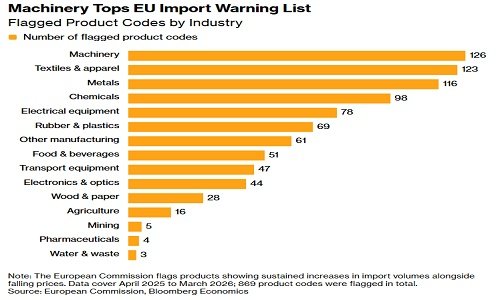
Chemicals are next on the list for action, along with machinery, textiles and metals:
- The key is the use of trade data from our partners Trade Data Monitor, and others
- As the chart shows, the EU plans to develop a ‘Warning List’ of key sectors at risk
- It will no longer just be using anti-dumping tools, which are slow and easy to avoid
- Instead, as with hybrids, it will simply limit volumes via quotas
Germany has been badly hit by the imports. And it, together with France, has asked the Commission to move quickly to protect these vital industries. As Bloomberg notes:
“The German push for stronger measures marks a radical shift in the country’s approach to China. Berlin has traditionally been more cautious given its export-driven economy and deep commercial ties with Beijing. German Chancellor Friedrich Merz has accused China of keeping the yuan artificially weak and said earlier this year that “we underestimated China’s power and economic strength.”
IMF SAYS CHINA NEEDS TO CHANGE ECONOMIC POLICY
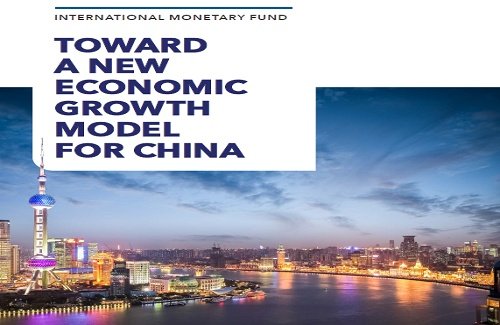
Essentially, the EU’s action confirms that China’s growth era is over. As the Wall Street Journal notes in an interview with the authors of a new IMF book:
“For decades, the Chinese state has had a deal with the people:
- Work hard, buy an apartment, climb the economic ladder and stay out of politics
- Now, for tens of millions of young Chinese, that deal is off
- The apartments are worth less than their parents paid
- The ladder leads to a grueling work schedule and a work title that doesn’t cover rent.”
As we have noted here many times, China faces a very difficult future due to its failure to resolve its demographic crisis. As the IMF authors warn, there is a growing risk of:
“A prolonged slowdown with weak domestic demand and deflation. The longer you wait, the bigger the problem becomes.”