
 US automakers were already under attack from two directions:
- They have lost their leading position in China – the world’s largest market
- GM’s market share has fallen from 15% to 9% due to lack of Electric Vehicle (EV) options
- And as noted in June, they have lost the robotaxi market to companies like Waymo and Zoox
- GM has closed its Cruise venture; Ford & VW have closed Argo AI
And now, their US model line-up is being thrown into confusion by Trump’s reversal of Biden’s support for US electrification.
The US majors had switched their model development programme to EVs. And now they have very few options for new gasoline models, as these normally take 3-4 years to develop.
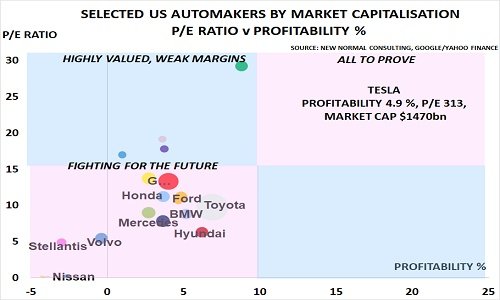
Their financial results reflect the challenges as the chart shows. Their profitability and Price/Earnings ratios are both weak. Tesla is the exception with a sky-high’s P/E ratio, due to its cult following.
AFFORDABILITY IS A MAJOR CHALLENGE
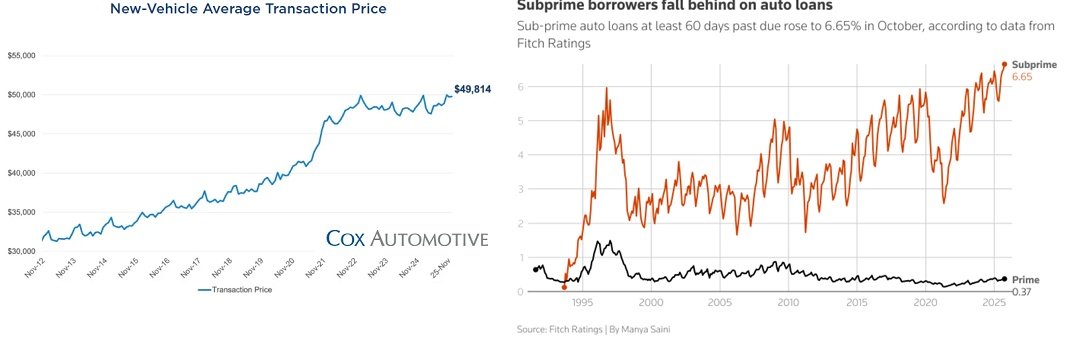
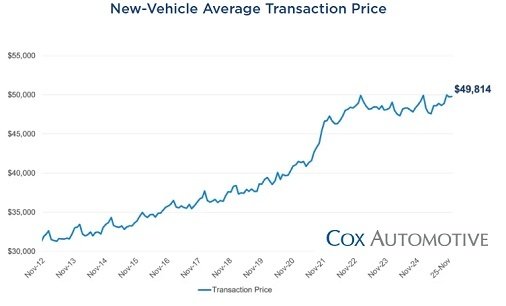
The core issue is pricing, as the charts show.
The Federal Reserve’s long stimulus programme meant interest rates were low, and borrowing was easy:
- Automakers took advantage; average new car prices rose from $32k in 2012 to $50k today
- But now interest rates are higher; auto loan rates are 9.5% for new and 14.3% for used cars
- Affordability is a real problem – 20% of borrowers are paying >$1k/month; 22% have 7+ year loans
- A record number of subprime borrowers (15% of total sales) are >60 days overdue on payments
And Trump’s trade war creates further uncertainty as he threatens to end his own USMCA Treaty.
It and the original NAFTA Treaty supported free trade for >30 years. Nobody knows if this will continue.
WE COULD BE SEEING A SECOND TRANSPORT REVOLUTION
Autos are the world’s largest manufacturing industry, employing millions of people worldwide in their major value chains. These roles all developed as a result of the first transport revolution:
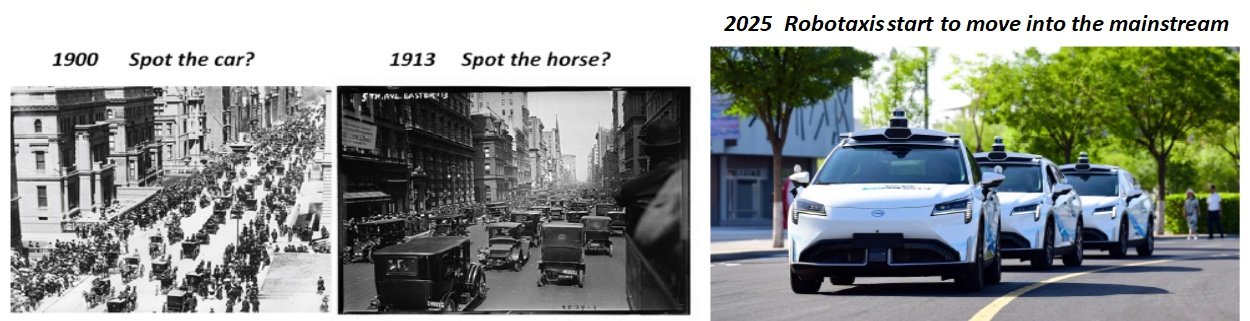
- Horses were still the dominant form of transport in 1900, as the chart shows of New York’s 5th Avenue’s Easter Parade
- Just 13 years later, a photo taken from the same position shows cars had almost completely taken over
Today, a second transport revolution is underway as robotaxis move into the mainstream. Alphabet-backed Waymo is already carrying more passengers than Lyft in its San Francisco service
And it is set to start operating in 14 US cities next year, as well as London and Tokyo.
Other services including Zoox and Wayve are also ready to launch, whilst Baidu has driven 100 million autonomous miles in China.
ROBOTAXIS ARE BETTER DRIVERS THAN HUMANS
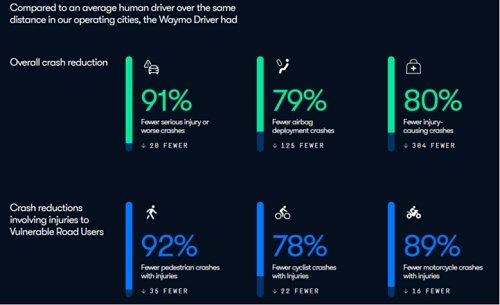
We all think we are better than average drivers. Robotaxis actually are better, as the chart showing Waymo’s safety record confirms. As The Atlantic reports:
“Every trip in a self-driving Waymo has the same dangerous moment. The robotaxi can successfully shuttle you to your destination, stopping carefully at every red light and dutifully following the speed limit. But at the very end, you, a flawed human being, will have to place your hand on the door handle, look both ways, and push the door open.”
Both it and China’s Baidu have now driven >100 million miles autonomously. They are not perfect, as the software is still evolving. But they are orders of magnitude better than humans:
- Robotaxis are ideal for transport in America’s major cities
- They are also ideal for America’s increasingly ageing population
- 10k/day Boomers have been retiring since 2011
- The Perennials 55+ are now the main source of population growth
- As they get older, eyesight goes and reactions slow
- But they don’t want to be trapped in the suburbs
It’s still early days with the robotaxi rollout. But the economics are very attractive.
Morgan Stanley report that Waymo costs $1.43/mile. And, of course, this cost is falling as more miles are driven.
Whereas buying a car has a high up-front costs, plus insurance, fuel, servicing and parking costs. And the average car is only driven 4% of the time – 1 hour a day.
The US automakers have been around a long time. It is too early to write them off. But Trump’s EV restrictions and their lack of robotaxi options suggests they risk running out of road sooner rather than later.