
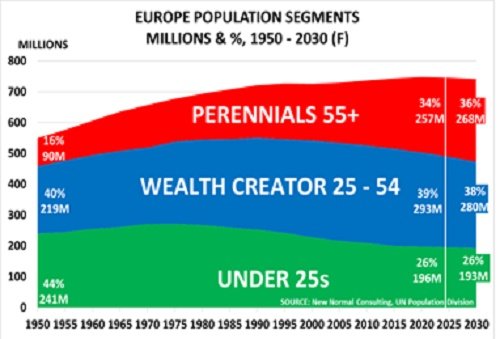
2025 is a pivotal year. It marks the moment when all Europe’s BabyBoomers (born 1946-70) move into the lower-earning, lower-spending Perennials 55+ cohort. They are now the major source of population growth:
- UN data suggests their numbers will rise from 257 million this year to 268 million in 2030
- They will be 36% of the population
- The number of Wealth Creators in the 25 -54 age range will fall from 293 million to 280 million
- The Under-25s cohort plateaus.
Europe’s relatively high domestic costs increases the need for companies to focus on developing new growth markets. Europe’s ageing population is the obvious place to start.
Counter-intuitively, this dynamic creates a major opportunity for those interested in profitable innovation.
The reason is that the Perennials are vastly under-served, as most consumer companies have continued to focus on younger generations. This dynamic makes it easier to succeed with new ideas, as the competition is limited.
Most Perennials are also rather bored with companies who assume their main need is for walking sticks and adult diapers.
 Sustainability and plastics recycling is another area which is opening up for major growth. Doing more with less is obviously an important issue for Perennials as they move into retirement.
It also fits with the need to invest in energy security, given the wider uncertainties. It is a key area for building resilience via ‘local-for-local’ solutions.
And it offers major opportunities for future profit as the technology starts to move from pilot to manufacturing scale.
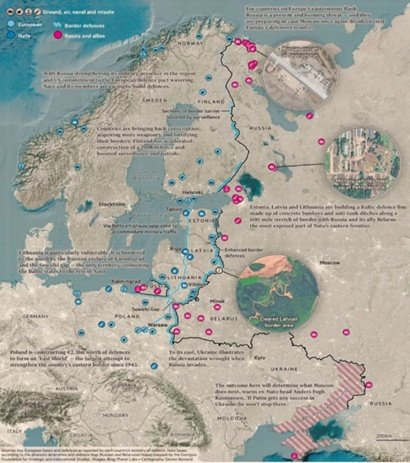 Defence, of course, is another major and fast growing opportunity. Vast sums of money are set to be spent in this area in Europe over the next few years, to make up for the lack of investment after 1989’s fall of the Berlin Wall.
Nobody thought there would ever be a land war in Europe again. And it makes no sense to now invest trillions of euros in out-of-date technology and products.
As Ukraine has demonstrated with drones, there is a major need for innovation and modern technology.
The chemical industry is critical for all of these areas. As the European Commission itself has acknowledged, “the sector is vital to Europe’s economy, underpinning the manufacture of almost all goods”.
The industry’s project management skills are also going to be in high demand, to develop and deliver the necessary new products and services on budget and to an accelerated timescale.