

The Strait of Hormuz has now been disrupted for nearly 8 months. And the world’s largest oil company, Saudi Aramco, is worried the disruption will continue, as its CEO, Amin Nasser, has confirmed:
- “The IMF has modeled a severe scenario where global economic growth falls to just 2% next year, while inflation rises above 6% (as the chart shows)
- The longer the disruption continues, the risk of this happening only grows
- And when energy becomes scarce or unaffordable, the most vulnerable suffer hardest and they suffer first”
He adds that “the supply resilience cushion is scarily thin…<6 bn barrels of commercial inventories remain today, with the vast majority not practically available.” (our emphasis)
THE IRAN WAR SHOWS NO SIGN OF ENDING SOON
 Leading energy company, Vitol, is also worried, as its CEO, Russell Hardy warned this month:
“We started this conflict with a crude crisis. Then it turned into a product crisis. Now it is turning into a shipping crisis.”
The issue is that only a few owners and crews are prepared to risk transitting the Strait:
- Many owners can’t obtain insurance due to Iranian attacks
- Bloomberg reported “at least” 23 attacks in the first 2 weeks of October
- These attacks aim to damage the engine room, taking the ship out of service
Instead, tankers are now engaged in a shuttle arrangement through the Strait.
They then transfer their oil cargoes to other ships for the onward voyage to Asia, Europe or the Americas.
This is very inefficient, as it ties up the ships for much longer.
Bloomberg estimate it now costs $20 – $25/bbl to ship a barrel of oil anywhere in the world.
OIL PRICES ARE NOW DIVERGING AROUND THE WORLD

We’ve highlighted the increasing trend towards regionalisation in recent years.
And now the Hormuz crisis means it is impacting crude oil prices:
- Regions with an oil surplus like the USA are seeing much lower prices
- The US buys locally from Canada, Mexico and Venezuela
- Their oil is cheap as it would cost a lot more to export it outside the region
- Regions with an oil deficit are paying much more, as Bloomberg confirm:
“Canadian crude in the US Midwest? Around $70. US shale oil in the Gulf of Mexico? That’s about $100. North Sea crude delivered in Rotterdam? That’s $125, give or take. And Omani crude shipped to southern China? That’s closer to $150.“
Before the Iran war, regional prices never varied by ~$5/bbl for similar grades. Today, China’s price is double the US mid-West.
GASOLINE, DIESEL, JET & BUNKER FUEL SUPPLY IS TIGHT
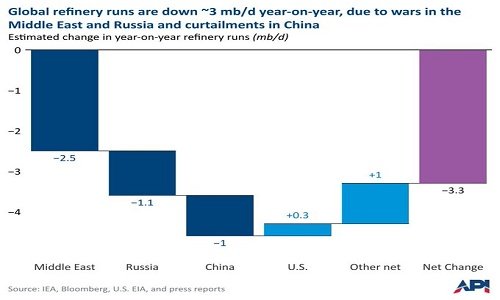
The disruption to oil markets is bad enough. But consumers don’t use oil – they use gasoline, diesel, jet & bunker fuel.
These products are running short. Supply is down 3.3mbd due to the wars in the Middle East & Ukraine, and China’s cutbacks, as the American Petroleum Institute chart confirms:
- The Middle East has lost 2.5mbd; Russia has lost 1.1mbd; China has lost 1mbd
- The only positives are an extra 1.3mbd from the US and Others
- Equally important is that shipping routes are longer and more expensive
- Insurance costs are also going through the roof, averaging up to 10% of cargo value
The question is ‘How long can these problems continue to increase, before something breaks in the value chain?’ As shipping experts Lloyds List Intelligence warned last week:
“The defining question for 2027 is therefore not whether global trade can continue moving. Recent experience suggests it can. The question is how much cost, inefficiency and human risk the industry is prepared to absorb to keep it moving.”